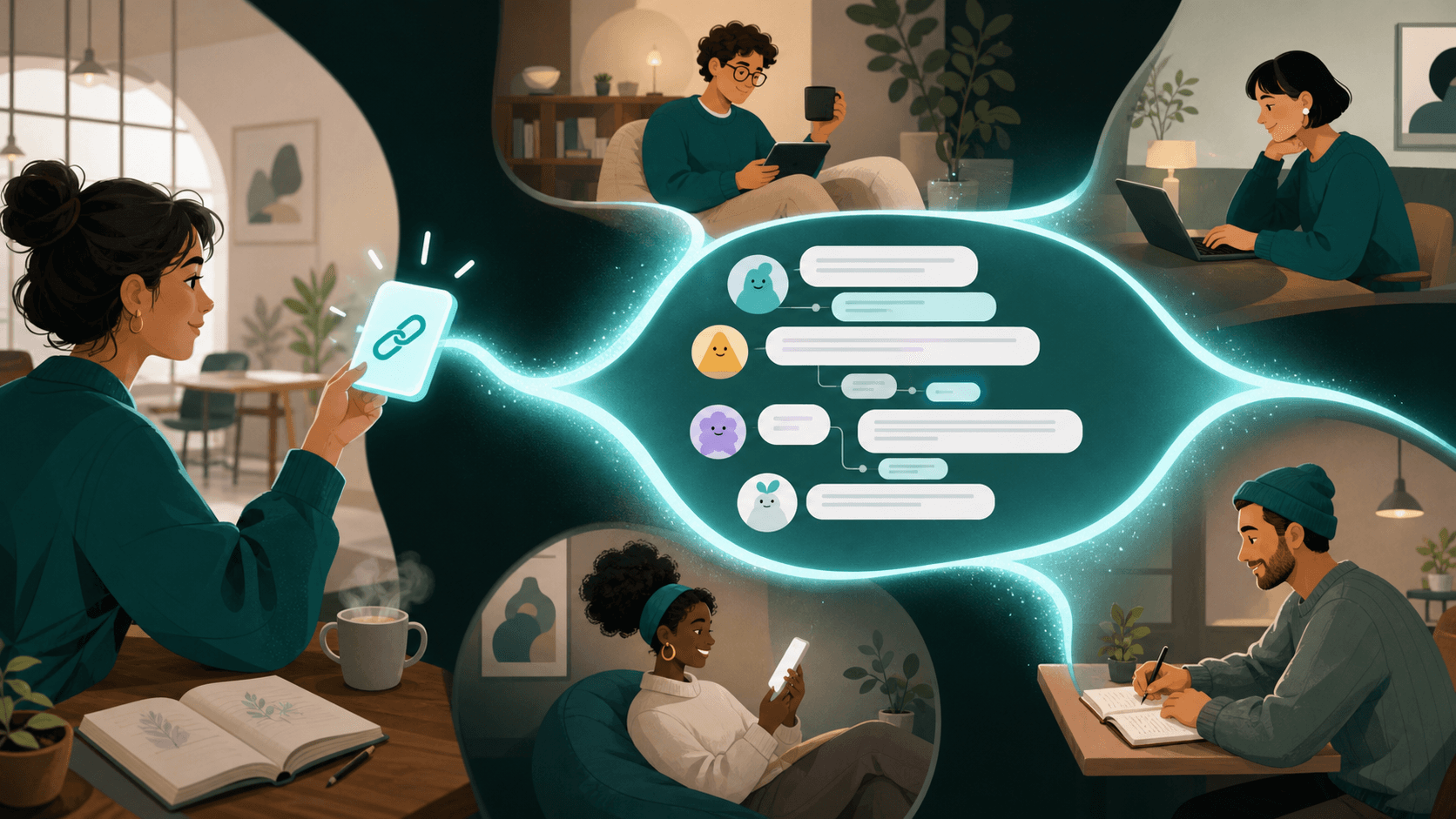
Wheesper lets people start or join a private discussion without providing a name, email address, or phone number. A creator opens a discussion, receives a private participant link, and shares it directly with the intended group.
Each participant receives a randomly assigned pseudonym that stays consistent within that discussion. There are no public participant profiles, and discussions are not listed in a public directory.
How a no-login discussion works
- A creator starts a guest discussion or signs in with email for a recoverable account.
- Wheesper generates a high-entropy participant link.
- People who receive the link can join without entering a name or email address.
- Wheesper assigns each participant a pseudonym for that discussion.
- Participants can post threaded replies while the discussion is active.
Guest creators receive a separate secret management link. Signed-in creators manage their discussions from a dashboard. Neither option requires participants to create a conventional account.
Which discussion format fits your situation?
Anonymous tools solve different problems. The right format depends on whether participants need to respond to one another, how widely the conversation should be shared, and whether the organizer needs an ongoing thread or a collection of separate answers.
| Format | Best for | Main strength | Choose something else when |
|---|---|---|---|
| Private pseudonymous discussion | Group feedback, sensitive questions, and peer conversation | Participants can exchange ideas without public profiles | You need verified identities or individually confidential submissions |
| Anonymous survey or form | Structured responses and measurable results | Easy aggregation and comparison | Participants need to ask follow-up questions or respond to each other |
| Public forum | Open communities and discoverable conversations | Broad reach and public participation | The topic or intended group is private |
| One-to-one encrypted messenger | Direct conversations between known people | Strong message confidentiality when end-to-end encryption is supported | You want a pseudonymous group thread without exchanging contact details |
| Live meeting or webinar Q&A | Time-bound audience questions during an event | Immediate interaction | People need time to reflect or contribute asynchronously |
Wheesper belongs in the first category: a private-by-link, asynchronous group discussion. It is closer to a threaded conversation than a survey, chat inbox, or public social network.
Private discussion forum or private discussion group?
People often use private discussion forum and private discussion group to describe a space where a defined audience can exchange messages away from public search. Wheesper can serve that purpose without asking participants to create named profiles.
Unlike a traditional forum with public categories, member directories, and many permanent channels, each Wheesper discussion is a separate private-by-link thread. It is best for a focused question or sensitive group conversation. An authenticated community platform is a better fit when you need verified membership, multiple forums, file libraries, or a permanent community hub.
What “private by link” means
A Wheesper discussion is accessible through its private participant link and is marked so search engines should not index it. The link is designed to be difficult to guess, but it is still a bearer credential: anyone who receives a forwarded copy may be able to open the discussion.
Share the link through a trusted private channel and avoid posting it publicly. Wheesper does not currently limit a participant link to a fixed number of uses.
Wheesper uses HTTPS/TLS to encrypt traffic in transit. This protects data while it travels between a browser and the service, but it is not end-to-end encryption. Authorised service administrators may access content when needed for safety, moderation, security, or legal compliance.
Anonymous to other participants—not invisible
Wheesper does not show discussion creators a participant’s name, email address, or raw IP address. Participants can still identify themselves accidentally through names, events, dates, writing style, or other details in their messages.
The optional Rewrite for privacy tool can reduce writing-style clues, but it does not remove identifying facts and cannot guarantee anonymity. Always review a message before posting it.
Creator controls
Discussion creators can:
- Share the participant link or send a neutral email invitation
- Remove individual replies
- Lock the discussion to stop new replies
- Choose whether the discussion remains open indefinitely or expires at a selected time
- Permanently delete the discussion
When a dated discussion expires, it becomes read-only; it is not automatically deleted. Existing content may remain available to people who have the private link until the creator deletes the discussion.
Participants can report a discussion or reply for review. Reports are handled by authorised Wheesper administrators rather than displayed publicly.
Anonymous email invitations
A creator can ask Wheesper to email the discussion link to an individual recipient. The neutral invitation does not name the creator, although the recipient may infer who sent it from the topic, timing, or surrounding context.
Postmark processes the recipient address to deliver the message. Wheesper does not store the raw recipient address in its application database; it keeps a secret-keyed fingerprint temporarily to limit duplicate invitations and abuse.
When Wheesper is a good fit
Private, pseudonymous discussion can help when status, embarrassment, or fear of repercussions might keep people silent. Common uses include:
- Workplace feedback: invite a defined team to discuss concerns or ideas without attaching public profiles to their replies.
- Classroom questions: give students a lower-pressure place to ask questions and respond to classmates.
- Community listening: gather candid perspectives from people who already received the private link.
- Peer-support conversations: let members talk under pseudonyms while keeping the discussion outside public search.
- Creative feedback: collect reactions to writing, art, plans, or early ideas without status or familiarity dominating the thread.
- Event follow-up: keep questions and reflections open after a meeting, workshop, or presentation ends.
Wheesper is not an identity-verification tool, an end-to-end encrypted messenger, or a public community platform. It works best for a defined group whose members receive the link privately and understand the discussion rules.
When should you choose Wheesper?
A tool like Wheesper is a strong choice when all or most of these statements are true:
- You want a conversation rather than a one-way questionnaire.
- Participants should not need to disclose a name or email address.
- The group is defined, and you can distribute a private link directly.
- Participants need threaded replies and time to respond asynchronously.
- The creator needs to remove replies, lock the conversation, or delete it.
- Application-level pseudonymity is appropriate for the topic.
Choose another tool when
- You need quantitative research: use a survey platform with question logic, exports, and statistical analysis.
- You need verified membership: use an authenticated workspace or community platform that can confirm each participant’s identity.
- You need one-to-one confidentiality: use a reputable end-to-end encrypted messenger.
- You need public discovery: use a moderated public forum or community platform.
- You need a link restricted to named recipients or a fixed number of joins: Wheesper’s current participant link does not provide those restrictions.
- You face severe safety or legal risk: seek specialist security, legal, or safeguarding advice instead of relying on application-level anonymity alone.
Benefits and trade-offs
| Benefit | Related trade-off |
|---|---|
| No participant name or email is required | The creator cannot verify who a participant really is |
| Fresh pseudonyms reduce status and identity cues | People may still reveal themselves through message content or context |
| A private link makes joining simple | Anyone can forward a participant link, so distribution still requires care |
| Threaded replies support a real group conversation | Anonymous interaction requires active rules, reporting, and moderation |
| Optional expiration can stop new replies at a chosen time | Expiration makes the thread read-only; it does not automatically delete it |
Start a private discussion
Create a clear topic, choose an expiration setting, and share the participant link only with the people you intend to invite. You can begin as a guest and optionally claim the discussion with an email account later.