Confidential means someone can connect a response to a person but limits who can see or use that information. Anonymous means a response is not linked to a known identity within the stated process.
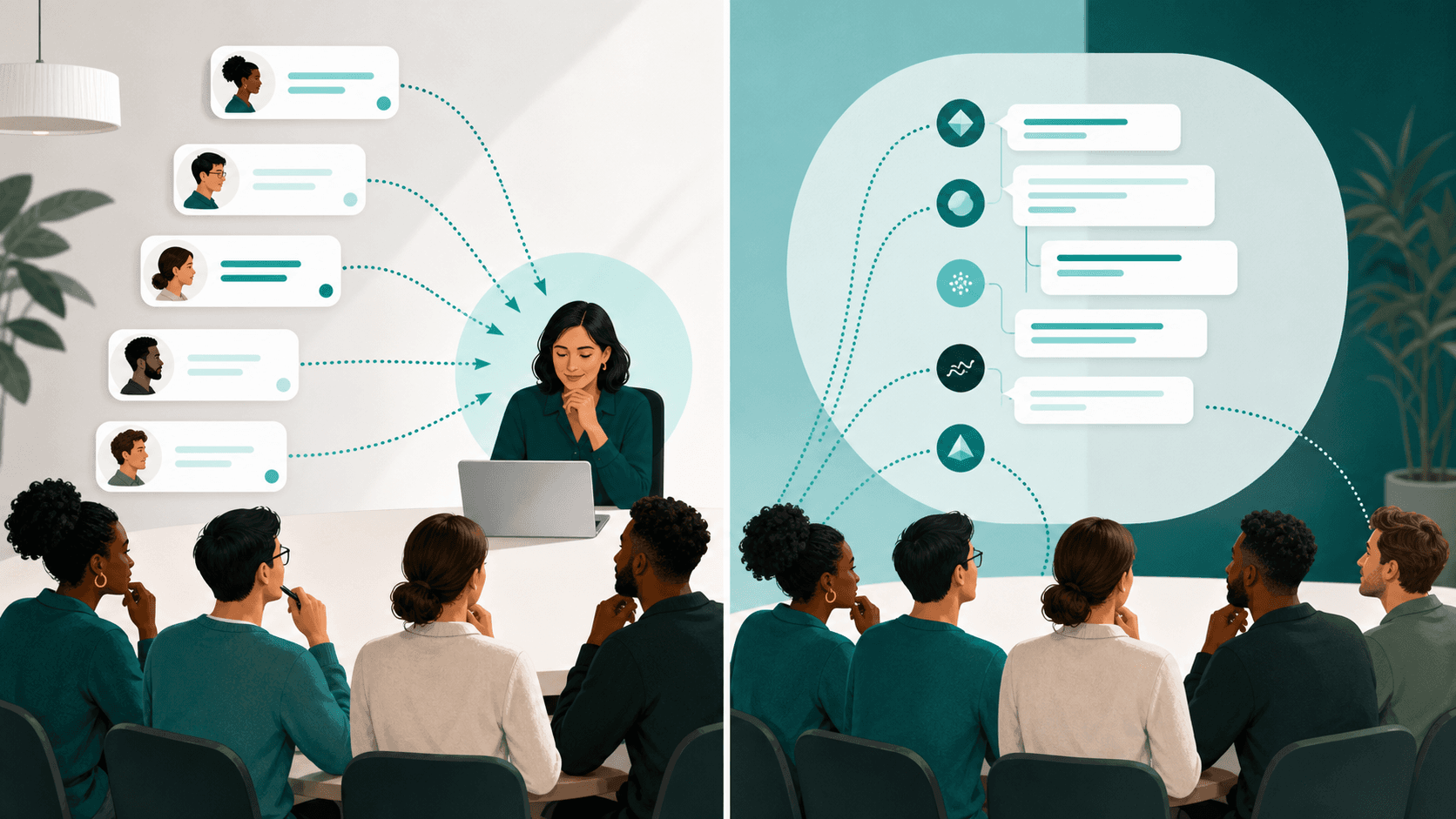
There is also a useful middle category: pseudonymous. Participants use assigned names instead of their real identities, allowing them to have an ongoing conversation without appearing under public profiles.
Wheesper is designed for private, pseudonymous group discussions. Participants do not need to provide a name or email address, and discussion creators see assigned pseudonyms rather than participant identities. This is application-level anonymity from other participants and ordinary creators—not a promise that no service provider processes technical data.
Anonymous, pseudonymous, and confidential compared
| Approach | What the organizer sees | Best for | Main limitation |
|---|---|---|---|
| Anonymous | Responses without a known identity | One-way feedback where candid input matters most | Direct follow-up may be impossible |
| Pseudonymous | Consistent aliases rather than real identities | Group conversations where participants need to reply to one another | Message content or context can still reveal someone |
| Confidential | Identities available to a restricted person or team | Cases requiring individual follow-up, verification, or support | Participants must trust the stated access controls |
These labels are meaningful only when the organizer explains who can access what. A discussion may be anonymous to other participants while the platform still processes authentication records, security signals, timestamps, or other operational data.
When anonymous or pseudonymous discussion works best
Choose an anonymous or pseudonymous approach when the main goal is to reduce social pressure and hear perspectives that people may hesitate to attach to their names.
- Workplace listening: surfacing concerns, patterns, or ideas before deciding what needs formal follow-up.
- Classroom questions: helping students participate without the pressure of speaking publicly.
- Community discussions: allowing members to exchange views on sensitive or divisive topics.
- Peer support: creating distance between a participant’s public identity and what they share.
- Creative feedback: reducing the influence of status, familiarity, and personal relationships.
Pseudonyms are particularly useful when participants need a real conversation rather than isolated survey responses. A stable alias lets the group follow who said what within one thread without revealing a public identity.
When confidentiality is the better choice
Choose a confidential process when someone must be able to identify and contact the participant. Examples include:
- A formal complaint or investigation that requires evidence and follow-up
- A safeguarding concern where a responsible person may need to act
- Individual support, case management, or mentoring
- Research that tracks the same participant over time
- Programs that must verify eligibility or group membership
A credible confidentiality notice should say what information is collected, who can access it, why it is needed, how long it is retained, and when disclosure may be required. Do not describe a process as anonymous if an administrator can readily connect responses to named people.
How Wheesper handles participant identity
Wheesper lowers the amount of identity information exposed inside a discussion:
- Participants can join without providing a name or email address.
- Each participant receives a randomly assigned pseudonym that remains stable within that discussion.
- Discussion creators do not see participant names, email addresses, or raw IP addresses.
- There are no public participant profiles or publicly searchable discussion listings.
- Messages are transmitted over HTTPS/TLS.
Wheesper is not end-to-end encrypted. Authorised administrators and infrastructure providers may process data as needed to operate the service, prevent abuse, review reports, maintain security, or comply with legal obligations. Cloudflare Turnstile processes security signals, and limited analytics use masked discussion paths rather than the private link itself.
The optional Rewrite for privacy tool can reduce writing-style clues, but it does not remove identifying facts and cannot guarantee anonymity. Names, dates, job details, unusual events, and writing habits may reveal a participant even when the platform does not display their identity.
Private links and creator controls
Wheesper discussions are private by link. The participant link is designed to be difficult to guess, but anyone who receives a forwarded copy may be able to join. The current link cannot be limited to named recipients or a fixed number of uses, so creators should share it through a trusted private channel.
Creators can remove replies, lock a discussion, choose an expiration time, or permanently delete the discussion. Expiration makes a discussion read-only; it does not automatically erase its content or invalidate the private link.
Participants can report a discussion or reply. Authorised Wheesper administrators may review reports and take proportionate moderation action.
What about anonymous email invitations?
A creator can ask Wheesper to send a neutral invitation containing the discussion link. The message does not identify the creator, although the recipient may infer who invited them from the topic, timing, or context.
Postmark processes the recipient email address for delivery. Wheesper does not store the raw address in its application database; it temporarily stores a secret-keyed fingerprint to limit repeated invitations and abuse. This feature is therefore private toward the recipient, but it should not be described as email that nobody processes.
A practical decision guide
- Do you need to contact an individual afterward? If yes, choose confidential or identified communication.
- Do participants need to reply to one another? If yes, pseudonymous discussion may work better than an anonymous form.
- Could the prompt itself reveal participants? Avoid requesting narrow demographic or identifying details.
- Can you distribute a private link responsibly? Remember that a recipient can forward it.
- Is the situation regulated or high-risk? Seek appropriate legal, research-ethics, security, or safeguarding advice.
Benefits and trade-offs
| Benefit | Trade-off |
|---|---|
| Less identity information is visible inside the group | Verifying who participated is difficult |
| Pseudonyms support candid, threaded conversation | Content and context may still identify someone |
| No participant sign-up details are required | Browser sessions and operational security data still exist |
| Private links make access simple | Links can be forwarded beyond the intended group |
| Creators can moderate without seeing real identities | Some cases cannot be resolved without confidential follow-up |
Which approach fits your group?
Use confidentiality when responsible follow-up matters more than identity separation. Use anonymous forms when you need independent responses without a conversation. Use a pseudonymous tool like Wheesper when a defined group needs to discuss a topic together without displaying names, emails, or public profiles.
Whichever approach you choose, explain its limits before people contribute. Accurate expectations protect participants better than an absolute promise of anonymity.